
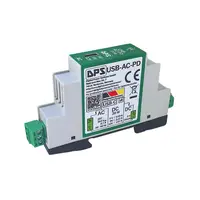
When a power supply fails, the same component is almost always to blame: the electrolytic capacitor. While semiconductors, transformers and circuit boards last for decades, the electrolytic capacitor starts aging from the very first hour of operation. A power supply without electrolytic capacitors eliminates this weak point at its root - and achieves calculated lifetimes of 70 years and more.
In this article we explain why electrolytic capacitors fail, how power supplies based on film capacitors work, and which applications benefit most from electrolytic-free power conversion.
Why is the electrolytic capacitor the weak point of every power supply?
Electrolytic capacitors store energy using a liquid electrolyte. That electrolyte is exactly the problem: over time it evaporates through the rubber seal of the can - relentlessly, and faster at higher temperatures. The consequences:
- Capacitance drops until the power supply can no longer keep its output voltage stable.
- The internal resistance (ESR) rises, causing the capacitor to heat itself up even further.
- The end result is total failure - often after 5 to 15 years, and much sooner at elevated temperatures.
Aging follows the well-known Arrhenius rule of thumb: for every 10 Kelvin increase in ambient temperature, the lifetime of the electrolytic capacitor is cut in half. Typical industrial-grade electrolytics are rated for 2,000 to 10,000 hours at 105 degrees Celsius. Inside a warm control cabinet or an LED luminaire, the electrolytic capacitor becomes a wear part - and it takes the whole power supply with it.
The solution: power supplies with film capacitors
A power supply without electrolytic capacitors replaces them with film capacitors. These contain no liquid electrolyte at all: nothing can dry out, nothing can leak. Film capacitors show practically no aging and tolerate high ripple currents and high temperatures far better.
The catch: film capacitors offer much less capacitance per volume than electrolytics. A simple one-to-one swap therefore does not work. The answer lies in digital control:
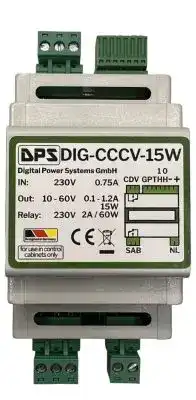
Digital Power Systems designs power supplies whose fast digital control loops need only a fraction of the capacitance a classic analog design would require. The result: power supplies entirely free of electrolytic capacitors - with an output ripple below 1 percent. Many models can also be configured and monitored digitally via Modbus RTU.
A 70-year lifetime: what does that mean in practice?
Without electrolytic capacitors, the dominant aging mechanism of the power supply disappears. The calculated lifetime of Digital Power Systems units is 70 years. In practice this means:
- No more preventive replacement of power supplies
- No unplanned downtime caused by failed power supplies
- Maintenance-free operation, even in hard-to-reach installation locations
- Sustainability: a device that lasts for decades saves resources and electronic waste
The technology originates from research at the Karlsruhe Institute of Technology (KIT) and received the KIT Transfer Award. Every unit is manufactured in Germany and individually tested.

Advantages of a power supply without electrolytic capacitors at a glance
- Calculated lifetime of 70 years instead of 5 to 15 years
- Insensitive to high ambient temperatures
- Output ripple below 1 percent thanks to digital control
- Digital monitoring and configuration via Modbus RTU (model-dependent)
- Maintenance-free, no electrolytic wear part
- Made in Germany, every unit individually tested
Typical applications
A power supply without electrolytic capacitors pays off wherever failures are expensive or replacement is difficult:
- Control cabinets and industrial automation: 24/7 operation at elevated temperatures
- LED lighting: the LED lasts 50,000 hours and more - the driver should not fail first
- Building technology and infrastructure: permanently installed, hard-to-access power supplies
- Railway, energy and critical infrastructure: long maintenance intervals, high reliability requirements
- USB charging infrastructure: permanently plugged-in chargers in furniture, vehicles and public spaces
Electrolytic-free power supplies from Digital Power Systems
Digital Power Systems offers a complete range of electrolytic-free power supplies:
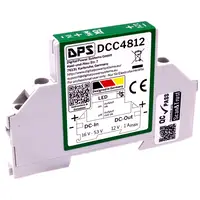
- AC/DC power supplies: mains-powered supplies without electrolytic capacitors
- DC/DC converters: for example the DCC4805, DCC4812 and DCC4824 series for 48 V systems, plus the digital Modbus converter DCP48M
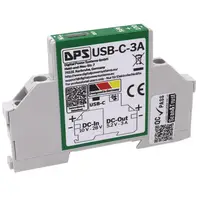
- USB power supplies: including the ultrathin USB-C-3A with a height of only 8.8 mm and the USB-AC-PD with USB-C Power Delivery
- LED power supplies: constant current and constant voltage sources such as the CCCV4812 and CCCV4824
The fastest way to the right model is the product finder.
Frequently asked questions
Why do electrolytic capacitors in power supplies fail so often?
The liquid electrolyte evaporates over time. Capacitance drops and internal resistance rises until the power supply fails. High temperatures accelerate the process dramatically: every additional 10 Kelvin cuts the lifetime in half.
Are film capacitors not much larger than electrolytics?
Per unit of capacitance, yes. That is why Digital Power Systems combines film capacitors with fast digital control that needs far less capacitance. The devices stay compact - the USB-C-3A, for example, is only 8.8 mm thick.
Where does the 70-year lifetime figure come from?
The 70 years are a calculated lifetime based on the aging models of all components used. Without electrolytic capacitors, the component with by far the shortest lifetime is removed, which multiplies the overall lifetime of the power supply.
Does a power supply without electrolytic capacitors cost more?
The purchase price can be higher than that of a standard product. Calculated over the lifetime, however, electrolytic-free supplies are usually much cheaper: there are no replacement units, no service call-outs and no unplanned production downtime.
Conclusion
The electrolytic capacitor is the component that limits the lifetime of virtually every conventional power supply. Power supplies without electrolytic capacitors - built with film capacitors and digital control - remove this weak point completely and reach calculated lifetimes of 70 years. For industry, LED lighting, building technology and every application with long operating hours, they are the more economical and more sustainable choice.
You can find all electrolytic-free power supplies from Digital Power Systems in the product overview.