

USB-DC-PD
Datasheet| Quantity | Unit Price (incl. VAT) | Unit Price (excl. VAT) | Saving |
| 1+ | EUR 34.75 | EUR 29.20 | — |
| 10+ | EUR 32.80 | EUR 27.56 | -6% |
| 25+ | EUR 30.84 | EUR 25.92 | -11% |
| 100+ | EUR 26.94 | EUR 22.64 | -22% |
| 500+ | EUR 25.24 | EUR 21.21 | -27% |
| More Quantity, More Savings. Please Quote! | |||
Key Features
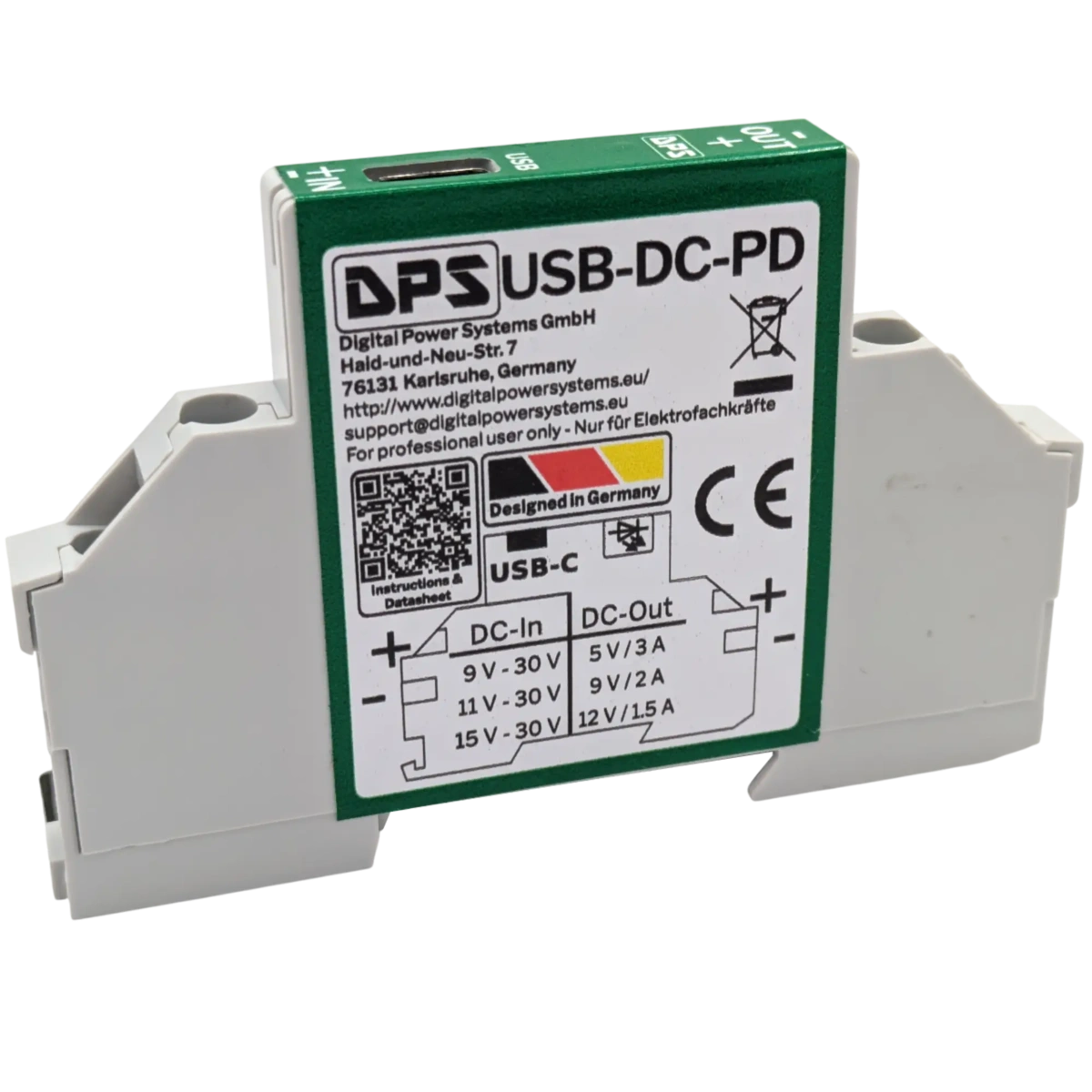
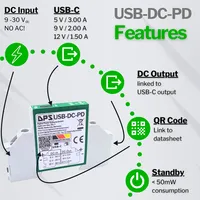
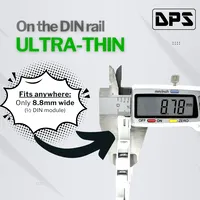
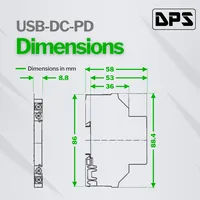
- Ultrathin: 8.8mm DIN Rail width
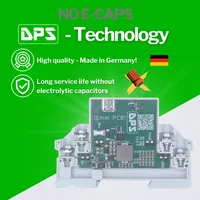
- Electrolytic capacitor free
- USB-PD Supported Levels:
- 5 Vdc - 3 Adc,mac
- 9 Vdc - 2 Adc,mac
- 12 Vdc - 1.5 Adc,mac
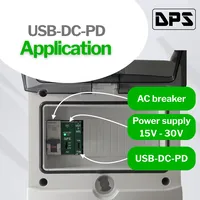
- 9 Vdc to 30 Vdc input voltage range
- Output short circuit proof
- Input Reverse Volarity Protection
- Green Power LED
- Low Conducted Emissions
Product Description
Downloads
Technical data
Check the specifications below to filter for products with matching attributes.
| ✓ | |
| DC |
Logistics Data
| GTIN / EAN | 4262542250015 |
| Weight | 0.03 kg |
| Dimensions | 89 x 9 x 58 mm |
| Country of Origin | Germany |
| HS Code | 8504409590 |
| Manufacturer | Digital Power Systems GmbH |
| Address | Bruchsaler Str. 18, 68753 Waghäusel-Kirrlach, Deutschland |
| shop@digitalpowersystems.eu | |
| Website | https://digitalpowersystems.eu |
Do you need support?
Have a question about this product? Our engineering team is here to help.
The power LED only turns on, when a load is detected. If no load is connected the LED and output voltage is off (0 V). If your load is not detected, most probably it does not comply to USB-PD standards. Try connecting a high quality load and measure the output voltage at the output voltage terminals.
Input minimum scales with output: 9 V DC for 5 V PD, 11 V DC for 9 V PD, 15 V DC for 12 V PD. All share a 30 V DC maximum input. The buck topology means input must always exceed output — a 12 V bus cannot produce 12 V PD output.
Three fixed PDO levels: 5 V / 3 A (15 W), 9 V / 2 A (18 W), 12 V / 1.5 A (18 W). The device is rated 18 W maximum; the 5 V profile is limited to 15 W by its 3 A. The device is PD-source-only.
Down to -30 V DC (spec table). Applying AC to the DC input destroys the device and is classified as misuse with no warranty coverage.
Both are handled without intervention. Indefinite short-circuit protection and indefinite open-circuit safe operation; no power cycle or reset is required after either condition clears.
Typical 90 % / peak 91 % per spec table. The 8.8 mm DIN housing plus electrolytic-cap-free design keeps self-heating low. Rated -40 °C to +50 °C; derating applies at elevated ambient — output current must be reduced to stay inside the thermal envelope.
Yes, the USB-DC-PD works with Raspberry Pi and has been tested with Raspberry Pi. It provides USB-C Power Delivery output at 5V/3A, 9V/2A, and 12V/1.5A, so a Raspberry Pi can negotiate the 5V/3A profile over USB-C. Make sure the Raspberry Pi model's current draw does not exceed the 3A available at 5V, and supply the USB-DC-PD with 9–30V DC on its input.
No — the O+/O– screw terminals are not a separate 5 V output and cannot be used as a stand-alone DC output. They are wired to the USB-C output and carry exactly the same voltage as the USB-C port: 0 V while no USB-C device is detected, otherwise the negotiated 5, 9 or 12 V. Warning: never connect a load that is only rated for 5 V to O+/O–; it receives 9 V or 12 V as soon as the connected USB-C device negotiates a higher level. For a permanent 5 V bus alongside full-power PD on USB-C, add a separate regulator or clarify with DPS.