
USB-C PD Hutschiene Charger: 15W DIN Rail Power
Supply phones, tablets, and laptops directly from your control cabinet's 9–30 V DC bus — with a USB-C PD charger that needs only 8.8 mm of DIN rail space and zero electrolytic capacitors.
- 8.8 mm DIN rail width
- 0 electrolytic capacitors
- 9–30 V DC input
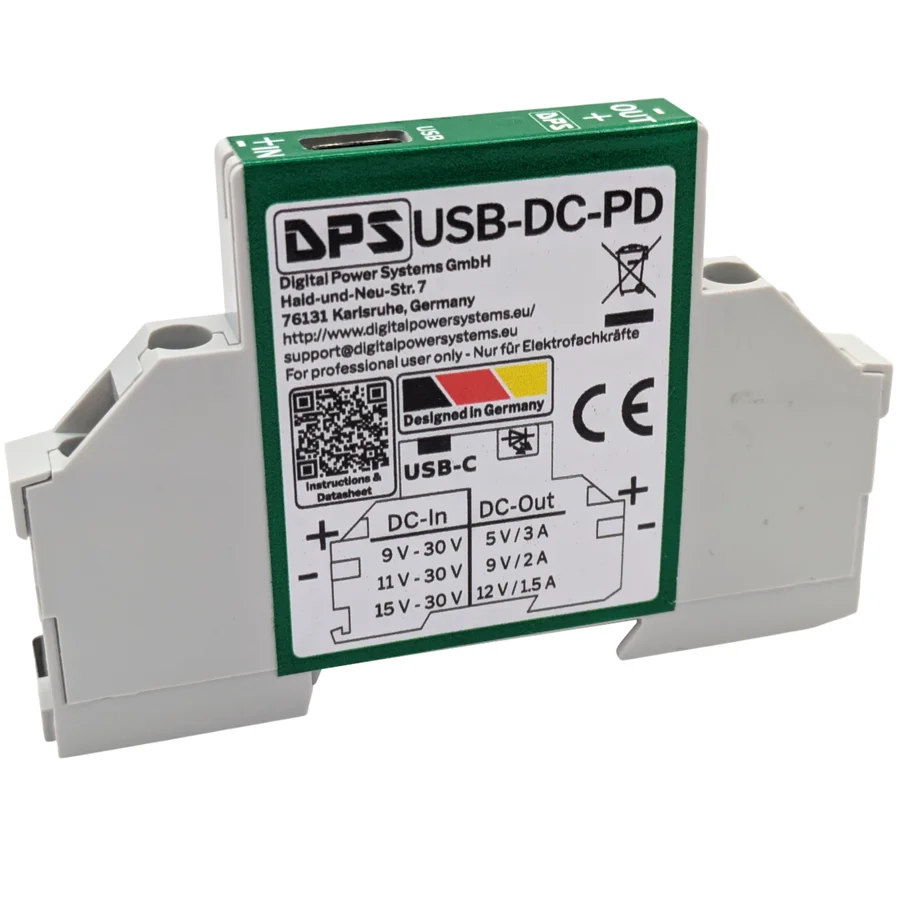
Ultra-slim 8.8 mm: pack more into every cabinet
At just 8.8 mm wide, the USB-DC-PD lets you add USB-C Power Delivery to a control panel without stealing DIN rail real estate. Its no-electrolytic-capacitor design eliminates the bulkiest aging component, so the unit stays compact and stays cool — no forced air, no maintenance.
- Mounts on standard 35 mm DIN rail (EN 60715)
- Natural convection cooling — no fan to fail
- Operating temperature: −40 °C to +50 °C
Download the datasheet for full mechanical dimensions.
USB-C Power Delivery: three fixed voltages, auto-negotiated
No manual switching — the USB-DC-PD senses the connected device and delivers 5 V, 9 V, or 12 V up to 18 W, safely and automatically. It supports the most common PD profiles: 5 V/3 A for phones, 9 V/2 A for tablets, 12 V/1.5 A for laptops and industrial peripherals.
- 5 V / 3 A (15 W)
- 9 V / 2 A (18 W)
- 12 V / 1.5 A (18 W)
- PD source only — always safe, no reverse power flow
The output appears on a standard USB‑C receptacle; auxiliary screw terminals provide a 5 V tap for basic monitoring or low‑power sensors (see datasheet for wiring).
9–30 V DC input: runs from your existing DC bus
Connect the USB-DC-PD directly to your 12 V or 24 V DC control cabinet supply — or any DC source between 9 V and 30 V. The integrated buck converter maintains stable output even if the input sags or surges, so USB-C devices see clean, regulated power.
- 9 V minimum for 5 V PD output
- 11 V minimum for 9 V PD output
- 15 V minimum for 12 V PD output
- Reverse polarity protection to −28 V
Because it’s a buck (step‑down) topology, the input voltage must exceed the target PD level. If your bus supplies only 12 V, 9 V and 5 V PD are still available; for full 12 V PD output you need at least 15 V input.
No electrolytic capacitors: why that matters for your uptime
Electrolytic capacitors are the #1 wear‑out component in power supplies. The USB-DC-PD eliminates them entirely. That means no dry‑out, no bulge, no sudden failure after years in a warm cabinet. The result is a service life measured in decades, not capacitor lifetimes.
- Ceramic and film capacitors only — no liquid electrolyte
- Lower self‑heating → better thermal headroom at full load
- Peak efficiency 95 % (typical 93 %) — less waste heat
Combined with the 8.8 mm housing and convection cooling, the thermal design keeps internal temperatures low without a fan, so reliability is predictable and consistent.
How USB-DC-PD eliminates your USB‑C reliability risk
| Criterion | Typical DIN‑rail DC‑DC converter | USB-DC-PD |
|---|---|---|
| USB‑C PD support | None — fixed voltage only | 5 V / 9 V / 12 V auto‑negotiated |
| DIN rail width | Often 22 mm or wider | 8.8 mm |
| Electrolytic capacitors | Typically present — limited life | Zero electrolytic — no wear‑out |
| Efficiency | 80–90 % typical | 93–95 % |
| Short‑circuit / open‑circuit behaviour | May latch off or require reset | Indefinite protection; auto‑recovery |
| Reverse polarity protection | Often external diode required | Built‑in down to −28 V DC |
Switching to the USB-DC-PD means you can replace a legacy fixed‑voltage converter with a smarter, smaller unit that handles the most common USB‑C charging profiles, without sacrificing protection or reliability.
Built to handle real‑world wiring mistakes
The USB-DC-PD shrugs off reverse polarity, sustained short circuits, and open‑circuit conditions — no intervention needed.
- Input reverse polarity protection: tested to −28 V DC (survives brief −30 V)
- Output short circuit: indefinite hold; resumes normal operation when fault clears
- Open circuit: safe indefinite operation; output off until a compliant PD load is connected
- Low conducted emissions for clean EMI profile in control cabinets
One note: applying AC voltage to the DC input terminals will destroy the unit; this is classified as misuse and is not covered by warranty. The device is designed for DC inputs only.
FAQ
The power is off despite input power connected. Was mache ich falsch?
The power LED only turns on when a load is detected. If no load is connected, the LED and output voltage are off (0 V). If your load is not detected, it most likely does not comply with USB‑PD standards. Try connecting a high‑quality load and measure the output voltage at the output voltage terminals.
What is the minimum DC input voltage required for each USB‑PD output level?
Input minimum scales with output: 9 V DC for 5 V PD, 11 V DC for 9 V PD, 15 V DC for 12 V PD. All share a 30 V DC maximum input. The buck topology means input must always exceed output — a 12 V bus cannot produce 12 V PD output.
What USB‑PD output levels and currents are supported?
Three fixed PDO levels: 5 V / 3 A (15 W), 9 V / 2 A (18 W), 12 V / 1.5 A (18 W). Nameplate is 15 W but the 9 V and 12 V profiles deliver up to 18 W. The device is PD‑source‑only.
What reverse‑polarity input voltage can the unit survive?
Down to −28 V DC (spec table); section 1.2 quotes −30 V. Applying AC to the DC input destroys the device and is classified as misuse with no warranty coverage.
How does the unit behave during an output short circuit or open circuit condition?
Both are handled without intervention. Indefinite short‑circuit protection and indefinite open‑circuit safe operation; no power cycle or reset is required after either condition clears.
What is the efficiency, and how does the 8.8 mm DIN rail width affect thermal derating?
Typical 93 % / peak 95 % per spec table (overview table cites 92 % peak). The 8.8 mm DIN housing plus electrolytic‑cap‑free design keeps self‑heating low. Rated −40 °C to +50 °C; derating applies at elevated ambient — output current must be reduced to stay inside the thermal envelope.
Is an auxiliary or screw‑terminal 5 V output available alongside the USB‑C port, as on the USB‑AC‑PD?
No — single output rail only. USB‑C carries the negotiated PD voltage (5/9/12 V); the O+/O‑ screw terminals are labelled in the pinout table as a 5 V output. For a guaranteed permanent 5 V bus alongside full‑power PD on USB‑C, clarify with DPS or add a separate regulator.
Pricing & shipping
| Quantity | Price / unit |
|---|---|
| 1+ pcs | EUR 34.75 |
| from 10 pcs | EUR 32.80 |
| from 25 pcs | EUR 30.84 |
| from 100 pcs | EUR 26.94 |
| from 500 pcs | EUR 25.24 |
✓ Free shipping on orders from EUR 10.00
Live pricing, updated automatically. Prices include 19% VAT, plus shipping.
Related products
- USB-AC-PD — same compact USB‑C PD with a wide‑range AC input (100–240 V AC), ideal when your cabinet runs on mains voltage.
- Engineered in Germany
- CE / EMC compliant
- Manufacturer warranty
- B2B terms & volume pricing